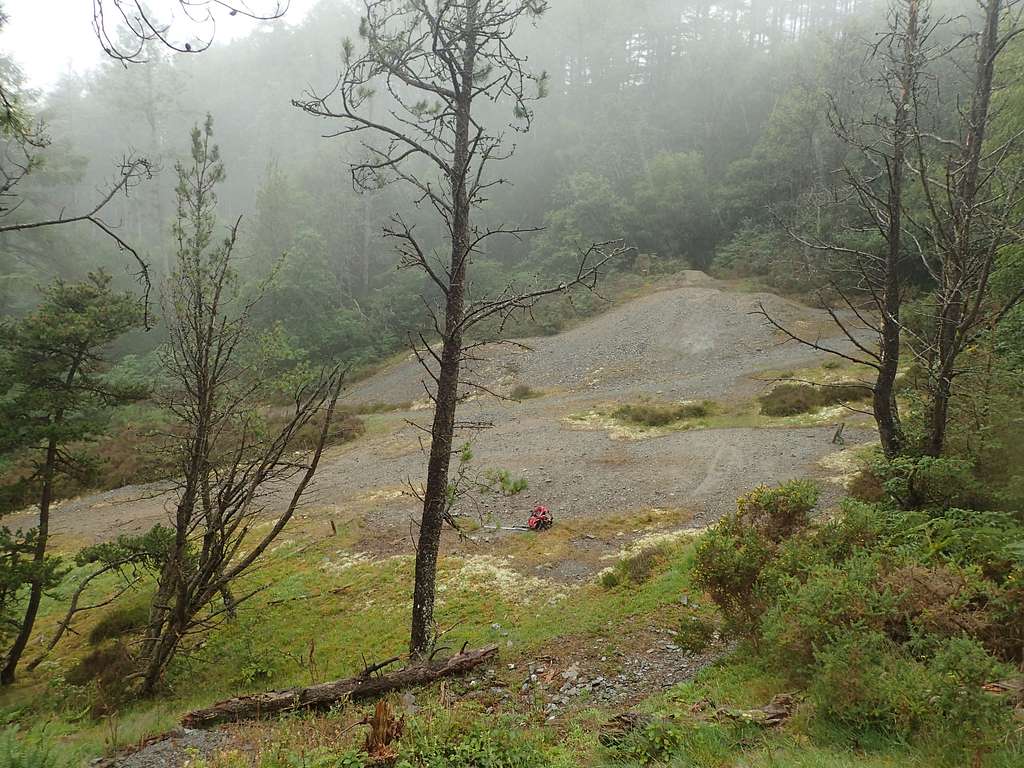



Talybont is in all likelihood an ancient mine, as stone hammers have been found in the vicinity. Recorded history, however, begins in 1585 when twenty miners were set to work at Alltycrib by the Society of Mines Royal. In 1617 the leases passed to Sir Hugh Myddelton, who retained them until his death in 1631.
The principal relic of the Myddelton period is an adit known as Myddelton’s Adit, located at SN 648593. This is the oldest known level on the south side of the hill. Driven in a northerly direction, it was intended to intersect what later became the Western Engine Shaft. The level itself is a fine example of a coffin level - a passage driven entirely by hand tools, without the use of explosives. Remarkably, it remains accessible today (2026).
In 1637 the mines were taken up by Thomas Bushell, who was responsible for driving Bushell’s Level, of which no trace survives today and whose exact position remains uncertain. At that time the dressing floors were situated on the site of the present playground just below Alltycrib Hill. Bushell was also responsible for sinking Old Whim Shaft. Although the shaft has now collapsed, its position can still be identified on a surface outcrop of the lode on the summit of the hill just above the track.
Following the decline of Bushell’s operations and the passing of the Society of Mines Royal, little further work was carried out. Curiously, the Company of Mine Adventurers showed no interest in the property, and the mine lay virtually idle until the coming of the second phase of the Industrial Revolution.
By the 1830s industrial expansion was accelerating rapidly across the country. Mechanical technology advanced at an unprecedented pace, and the construction of new factories and housing created a growing demand for lead. The metal was required for plumbing, gas pipes, and roofing. In 1830 lead sold for £12-3-6 per ton; by 1836 the price had almost doubled to £24-2-10.
These favourable prices attracted the attention of the Flintshire Smelting Company, which in 1839 began driving a deep adit at the lowest practical horizon in order to intersect the mineral lodes crossing Alltycrib Hill. Two principal parallel mineralised faults cross the hill, later referred to as the North Lode and South Lode.
The adit was begun at Y Wern, in the centre of Talybont village. The location was advantageous, as the River Ceulan flowed less than forty yards from the portal, providing ample water for ore dressing.
Initially the adit was driven on a weak vein in a straight line for approximately 185 yards, at which point it intersected the South Lode. The heading was then turned slightly eastward before continuing towards the North Lode, which was explored for a short distance both east and west.
The level was subsequently carried a little farther north, where an underground shaft — later known as the Eastern Engine Winze — was begun. This was sunk in an attempt to intercept the North Lode on its underlie, the veins having northward.
From the South Lode the deep adit was continued towards the North Lode, but it passed approximately thirty feet east of Thomas Bushell’s Old Whim Shaft, possibly owing to surveying error. Hitting the shaft precisely would in any case have been extremely difficult due to the underlie of the vein and the probability that the shaft itself contained numerous deviations, making accurate dialling almost impossible.
At this point matters began to go wrong. The adit eventually broke into old workings on the North Lode some fifteen to twenty fathoms above the former bottoms.
Faced with this setback, the miners attempted to salvage the situation by sinking the Eastern Engine Winze, a vertical shaft driven underground on the Alltycrib fault in an effort to reach the North Lode at greater depth. This was intended to gain access to the lowest levels of the earlier workings, which the deep adit had failed to reach.
The deep adit was extended northward and the shaft begun, but after an expenditure of approximately £4,000 on development work the mine was abandoned. Records mention the sale of twenty-five tons of ore in 1845, though no further production is recorded; this material probably came from the South Lode.
By 1857 the mine was described as “lately abandoned due to poverty in depth.” The operators had failed to work below the earlier workings.
Roy Fellows notes:
I suspect that the old miners had already taken everything from this area anyway.
At the time, few could have imagined that this modest mine would soon become the centre of a remarkable sequence of events involving deception, financial manipulation, and fraud on a considerable scale. Over the following thirty years some of the most dubious figures in nineteenth-century mining promotion would become involved.
In London, an eleven-year-old servant boy named Joseph Fell was working quietly with his father at the Bank of Scotland. Less than a mile away, Richard Barabee Fastnedge, a young man from Oxfordshire, had established an office as an East India trader. Neither could have been aware of the other, yet their careers would eventually converge in a manner that would later be remembered as one of the most notorious mining promotions of the period.
In 1850 Mathew Francis became involved, and his company worked the mine until 1853. In 1854 the Welsh Potosi Company, under T. A. Wilkinson, took over operations and continued working until 1857. Their activity left behind Wilkinson’s Level, which remains accessible today. The company also worked nearby mines including Esgair Hir and Esgair Fraith.
After their departure the mine passed through a succession of operators until 1871, when the Alltycrib Silver Lead Mining Company assumed control. The driving force behind this venture was the notorious Joseph Fell, later associated with one of the greatest mining frauds of the era: the Cambrian Mining Syndicate, which operated the neighbouring Esgair Fraith and proved far more successful at extracting funds from shareholders than ore from the ground.
Fell’s principal associate was R. B. Fastnedge, and together they managed to maintain investor confidence until the enterprise collapsed in 1875, having produced only 314 tons of lead ore.
Undeterred, Fell promoted a new venture — the Talybont Silver Lead Mining Company Ltd, capitalised at £30,000 in £1 shares. The intention, however, was not to attract new investors immediately. Instead the company was formed to acquire the assets of the previous company from the liquidator.
Of the total share capital, 25,000 shares were issued in exchange for the old company’s assets, while the remaining 5,000 were retained. Fell, Fastnedge, and their associates had effectively manoeuvred themselves into complete control of the enterprise.
By August 1875 the assets of the former company had somehow passed into the hands of three individuals — C. F. Kemp, F. Nalder, and G. H. E. Brown — who subsequently sold them to Edward Hilton. In November of that year the new company acquired both the mineral lease and the former company’s assets from Hilton in exchange for the 25,000 shares, with Hilton becoming chairman.
What followed was yet another elaborate scheme played upon the shareholders. The concern continued until 1880.
After this the mine once again passed through a succession of operators until the final company, Talybont Lead Mines Ltd, was incorporated in 1910. This concern was managed by Edward Evans, who also operated Bwlch Glas and the Leri Stores in Talybont.
This last company drove Pryce’s Tunnel using Kelldrills and erected dressing floors at the Cwm Leri Deep Adit, which was used for the disposal of slimes. The old mine offices at Y Wern were also utilised during this period.
Roy Fellows notes:
There was, until recent years, a plaque bearing the name of this company at the gates.
Y Wern is now a private residence.
Today much of the old workings remain accessible to modern explorers. The principal feature of interest is the Deep Adit, which had been lost until 2005 when the air shaft was cleared at its base, allowing access by rope techniques. There is no access at Y Wern.
Wilkinson’s Level is also open, as is Myddelton’s Adit.
May be pre-Roman
| Year | Activity |
|---|---|
| 1641 | 200fm level had been driven by Thomas Bushell to intercept ‘drowned work 38 fathoms deep’. The site of this adit has not been determined. |
| 1720s | 150 tons of lead ore raise by the Mine Adventurers. |
| c1750 | A Shrewsbury based company extracts a good deal of ore. |
| c1800 | Bick believes best years of mining were over by this date, and any further attempts were doomed to ruin. |
| 1840s | Company from Flintshire drove a crosscut under the village, which became the Deep Adit to interesect workings 20fm above old bottoms, but little else was done. |
| 1850 | Promoted by Matthew and Absalom Francis as the Alltycrib Silver Lead Mine. Flat rods in deep adit driven by a 28ft waterwheel for pumping. |
| 1851 | 1 ton lump of solid galena appears at the Great Exhibition. |
| 1852 | 231 tons or ore sold, but production deteriorates. |
| 1854 | Mine up for auction. |
| 1859 | Revival under secretary J.H. Murchinson, intent on driving deep adit further to intercept lodes further into the hilside. This changed when ore was found near the summit, and two adits 15 fm depth apart driven to exploit the discovery. |
| 1864 | Ore exhausted and deep adit had not uncovered any new discovery, only 200 tons of ore raised since 1859. |
| 1869?? Bick says 1879 | Aberystwyth Foundry installs underground steam pumping engine for Robert Girdwood. Girdwood leaves, work continued on the new shaft on the now named ‘Champion Lode’ by the Alltycrib Silver Lead Mining Company. This was planned to sink to the 40fm level to meet an extension of the deep adit. About 200 tons of ore raised during this time. |
| c1870s? | Talybont Silver Lead Mining Company takes over, breaking into old working an raising some ore. |
| 1878 | Ore exhausted, company reduced to ‘scratching about on surface’ |
| 1885 | Absalom Francis returns, pumping out the engine shaft and raising about 250 tons of ore. |
| 1891 | Production Ceases. |
Access Agreement between CAL and NRW/WG was terminated in 2022. Documentation for this lapsed agreement available here
https://buddlepit.co.uk/mine-explorer/Library/Library.html?doc=20966
External Links
Publications (49)
- (1850); Allt y Crib - Prospectus; 4 pages
- (1850); Allt y Crib; 1 pages
- (1850); Cardiganshire - MJ Articles; 2 pages
- (2001); WMS Newsletter Issue 44 Apr; 10 pages
- (2001); WMS Newsletter Issue 45 Dec; 14 pages
- (2002); WMS Newsletter Issue 47 Oct; 28 pages
- (2004); WMS Newsletter Issue 51 Winter; 32 pages
- (2005); WMS Newsletter Issue 52 Spring; 28 pages
- A metal mines strategy for Wales; 139 pages
- Anon; Talybon Wern Dressing Floor; 1 pages
- Bevins, R. E., (1994). National Museum of Wales Geological Series No.16 - A Mineralogy of Wales; ISBN: 0720004039; pp. 46,47,68,88,102,124.
- Bick, D.E. (1991); Old Metal Mines of Mid-Wales, The; North of Goginan - Part 3; pp. 37-38.
- Edited by D. J. Linton (2009); Welsh Mines & Mining - The Lode of History; 122 pages
- Fellows, Roy; Talybont Deep Adit - Photo Tour; 56 pages
- Foster-Smith, J.R.; NMRS (1979); British Mining 12 - Mines of Cardiganshire, The; ISBN 0 901450 14 6; pp.28-29.
- Francis (1874); Allt y Crib; 2 pages
- Francis, Absalom (1874); History of the Cardiganshire Mines; 3 pages
- Hall, G.W. (2014); Welsh Mines & Mining - Metal Mining in Mid Wales 1822-1921; 131 pages
- Hall, G.W. (2014); Welsh Mines & Mining - Metal Mining in Mid Wales 1822-1921; 131 pages
- Hughes, S.J.S.; NMRS (1990); British Mining 40 - Darren Mines, The; ISBN 0901450 36 7; p.34.
- Hughes, Simon & Anon; Talybont Deep Adit Plans; 15 pages
- Hughes, Simon J.S. (1971); BSA Proceedings Vol VI, No 46 - Mineral Field of Mid Wales, The; 8 pages
- Hughes, Simon J.S. (1976); Cardiganshire - Its Mines and Miners; 52 pages
- Hughes, Simon J.S. (1976); Papur Pawb - Newspaper Snippets ; 16 pages
- Hughes, Simon J.S. (1981); Mines of Talybont, The - Part1, From AD70 to 1800; 36 pages
- Hughes, Simon J.S. (1987); British Mining Memoirs No. 34 - George Greem Engineer & Entrepreneur, 1824-1895; 14 pages
- Hughes, Simon J.S. (1988); UK Journal of Mines & Minerals No 5 - Decline of Mining in Mid Wales and Prospects of Revival, The; 10 pages
- Hughes, Simon J.S. (2001); Talybont - Ein Canrif; 11 pages
- Hughes, Simon J.S. (2004); WMPT Newsletter April - Talybont - Some Recent work on Ancient Mining in Mid Wales; 15 pages
- Jarratt, Tony (1974); Logbook 1; 105 pages
- Jones O.T. (1922); BGS - Mineral Resources of GB (c1920s) Vol XX - Lead and Zinc: Cardiganshire & West Montogmeryshire; 242 pages
- Jones O.T. (1922); BGS - Mineral Resources of GB (c1920s) Vol XX - Lead and Zinc: Cardiganshire & West Montogmeryshire; 242 pages
- Lewis, W.J. (1951); Early Mining in Wales; 17 pages
- Libscombe (1870); Allt y Crib; 1 pages
- Liscombe & Co (1880); Mines of Cardiganshire, Montgomereyshire & Shropshire; 52 pages
- Louis, Henry (1896); Treatise on Ore Deposits -Cardiganshire; 12 pages
- Misc; Talybont Maps&Plans; 1 pages
- Nancarrow (1919); Nancarrow Cardiganshire Report; 21 pages
- Naylor, Peter (1981); PDMHS (Peak District Mines Historical Society) 08-1 Jun - Sir Hugh Myddelton The First Mines Adventurer; 6 pages (54-59)
- NMRS; British Mining 34 - Memoirs 1987; pp.11,13,42.
- NMRS; British Mining 41 - Memoirs 1990; p.64.
- NMRS; British Mining 93 - Memoirs 2012; pp.74-83,104.
- O.J. Jones (1922); Allt y Crib; 2 pages
- Palmer, M.; NMRS (1983); British Mining 22 - Welsh Potosi- "The Richest in all Wales"; ISBN 0 901450 24 3; pp.17,18.
- Rieuwerts, J.H. (1980); PDMHS (Peak District Mines Historical Society) 07-5 - Earliest Lead-Mine Soughs in Derbyshire, The; 74 pages (241-314)
- Rieuwerts, J.H. (1998); PDMHS (Peak District Mines Historical Society) 13-6 Win - Early Gunpowder Work in Longe or Cromford Sough, Derbyshire, 1662 - 1663 and 1676 - 1680; 5 pages (1-5)
- Spargo (1870); Allt y Crib & Llwyn Adda; 2 pages
- Talybont-Various Docs; 8 pages
- Timberlake, Simon (1994); PDMHS (Peak District Mines Historical Society) 12-3 Sum - Archaeological and Circumstantial Evidence for early Mining in Wales; 11 pages (133-143)