



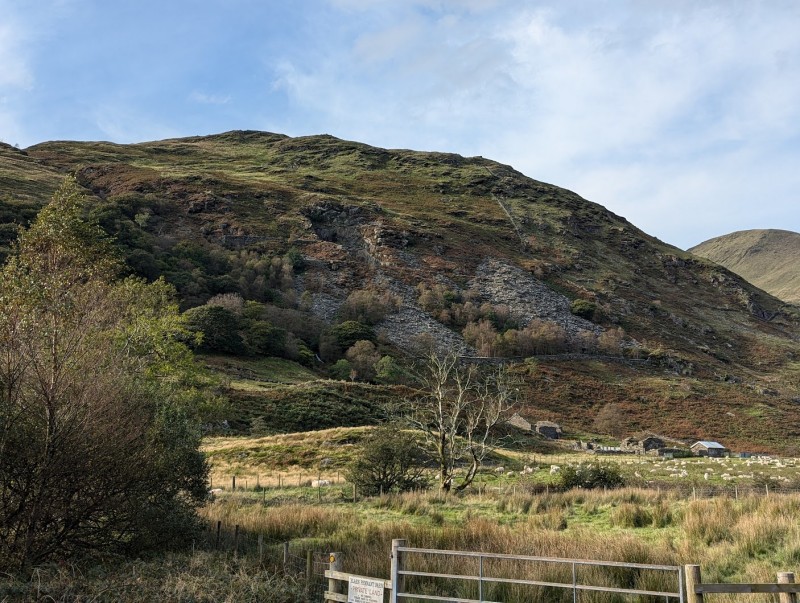
Primarily slate with mill and leat. Copper is attributed to a shaft and adit on site.
Two main terraces retain tramway embankments feeding into the incline head, and the incline itself features a large, remote-type drum house that is unusually substantial for a small quarry. Each working level carries remains of dressing sheds used for initial stone processing, and the retaining wall below the first working level features cantilevered steps. At the foot of the incline stands a massive rectangular structure whose purpose is unclear but suggests a significant ancillary process. The mill on the valley floor was built as an extension to an earlier building, while another nearby structure, possibly a dwelling, is now used for agriculture. A striking feature is the long, slate-covered tailrace leat, carrying spent water back to the river.
- 1850s, 60s Trialled for copper
- 1870s Worked for slate
- 1896 Auctioned
The quarry was developed on a steep hillside with three working levels, though the uppermost level was likely exploratory and never productive. Operations began in the 1870s, with activity probably ending by around 1880. Output from the hillside faces was hauled down a balanced incline to a water-powered mill on the valley floor, and the finished stone was then carted further down the valley for distribution.
External Links
Publications (4)
- (1993); WMS Newsletter Issue 29 Dec; 8 pages
- (1994); WMS Newsletter Issue 30 Jun; 4 pages
- Bick, D.E. (2003); Old Copper Mines of Snowdonia, The; p. 37
- Richards, Alun John (1991); Gazeteer of the Welsh Slate Industry, A; Gwasg Carreg Gwalch 978-0863811968


