



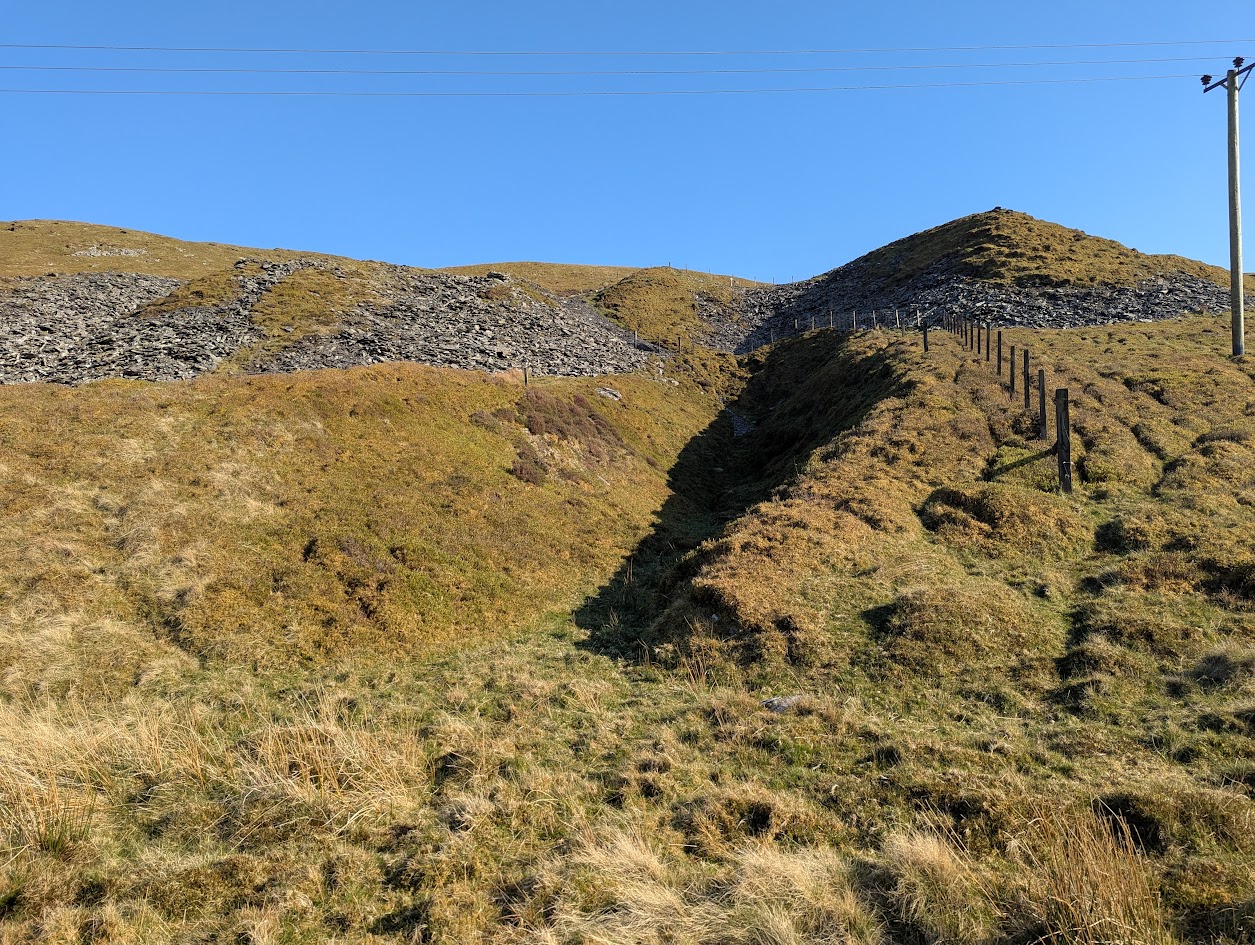
Small open workings.*
Very little survives, with only the pit itself clearly visible. Traces of a short access or drainage tunnel remain, along with scattered rubbish runs. The former tramway formation can still be discerned, marking the route used to move slate to the Ffridd incline.
The quarry was a small open pit worked intermittently during the 1860s and 1880s, later taken over by Cefn Du in 1886. Steam power was used for pumping water and hauling slate within the pit. Product was carried by tramway to the head of the Ffridd incline, but output was modest at only a few hundred tons per year, with one hundred and sixty tons recorded in 1883.
Publications (4)
- Lindsay, Jean (1974); History of the North Wales Slate Industry; David & Charles; pp.312; ISBN 0-71536-264-X
- Richards, Alun J. (2013); Slate Quarrying in Wales; Gwasg Carreg Gwalch; ISBN 1-84527-026-6
- Richards, Alun John (1991); Gazeteer of the Welsh Slate Industry, A; Gwasg Carreg Gwalch 978-0863811968
- Richards, Alun John, (1999); The Slate Regions of North and Mid Wales and their Railways; Gwasg Carreg Gwalch; 0863815596
