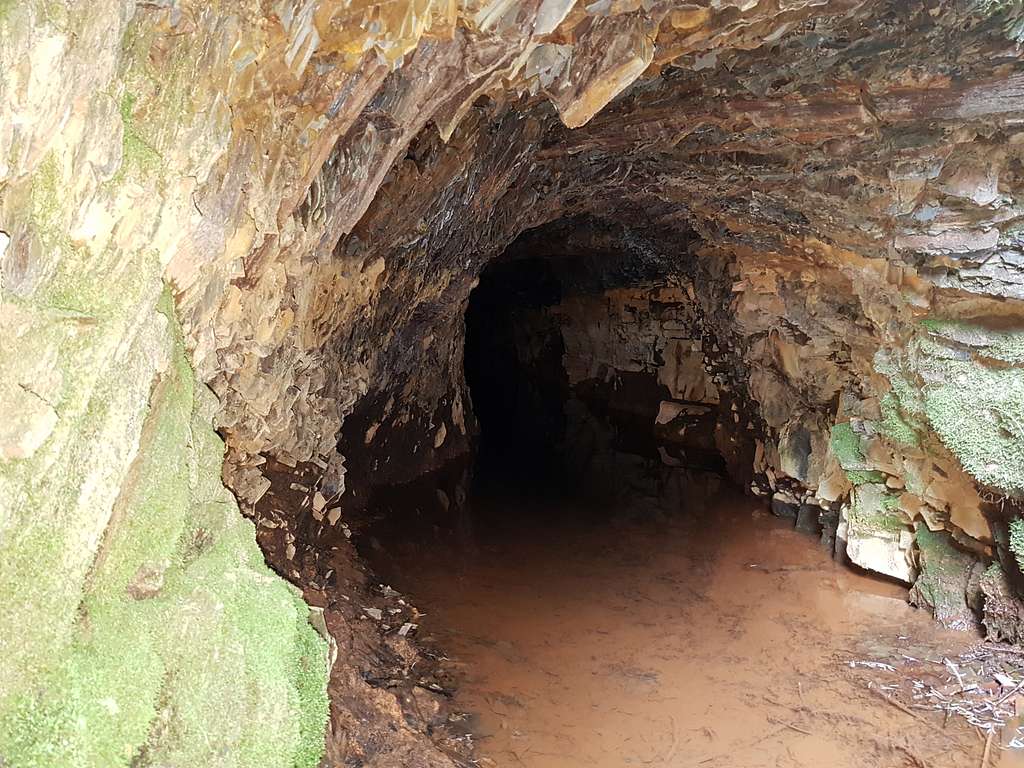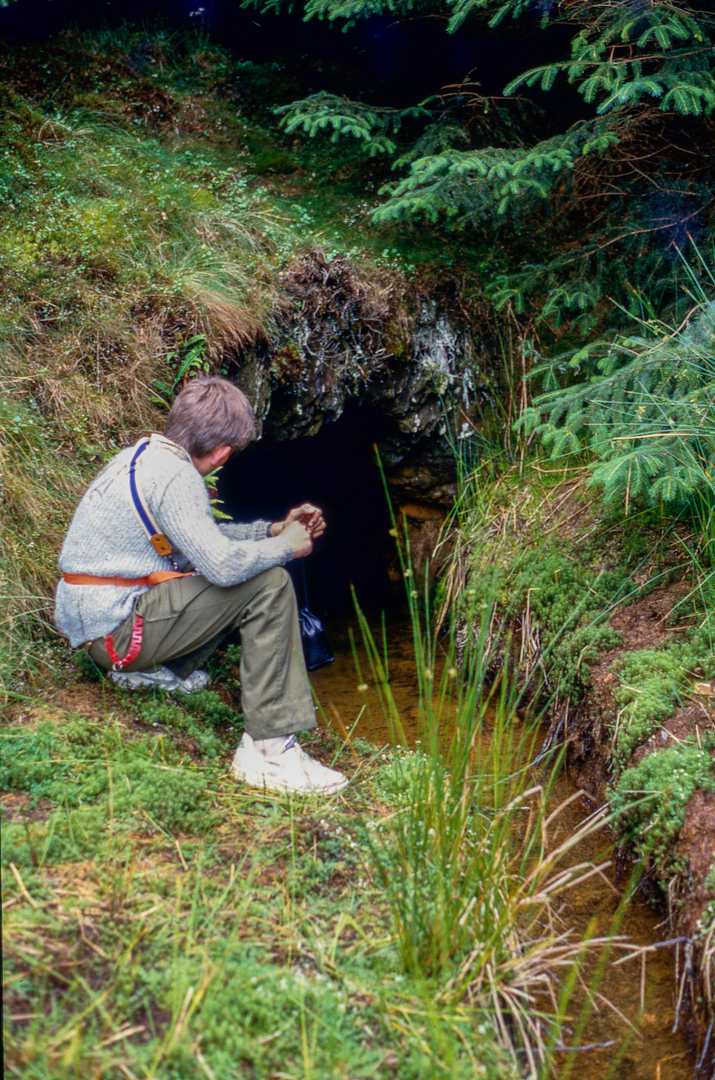



This small mine situated near to Nant y moch worked the Hafan lode from about 1800 to the turn of the 20th Cent. There has been a lot of speculation about a possible connection with the Hafan Mine, but this is not so. The inner reaches certainly dewater into Hafan but by a natural fissure which is the structure of the lode, ie, a mineralised natural open fissure.
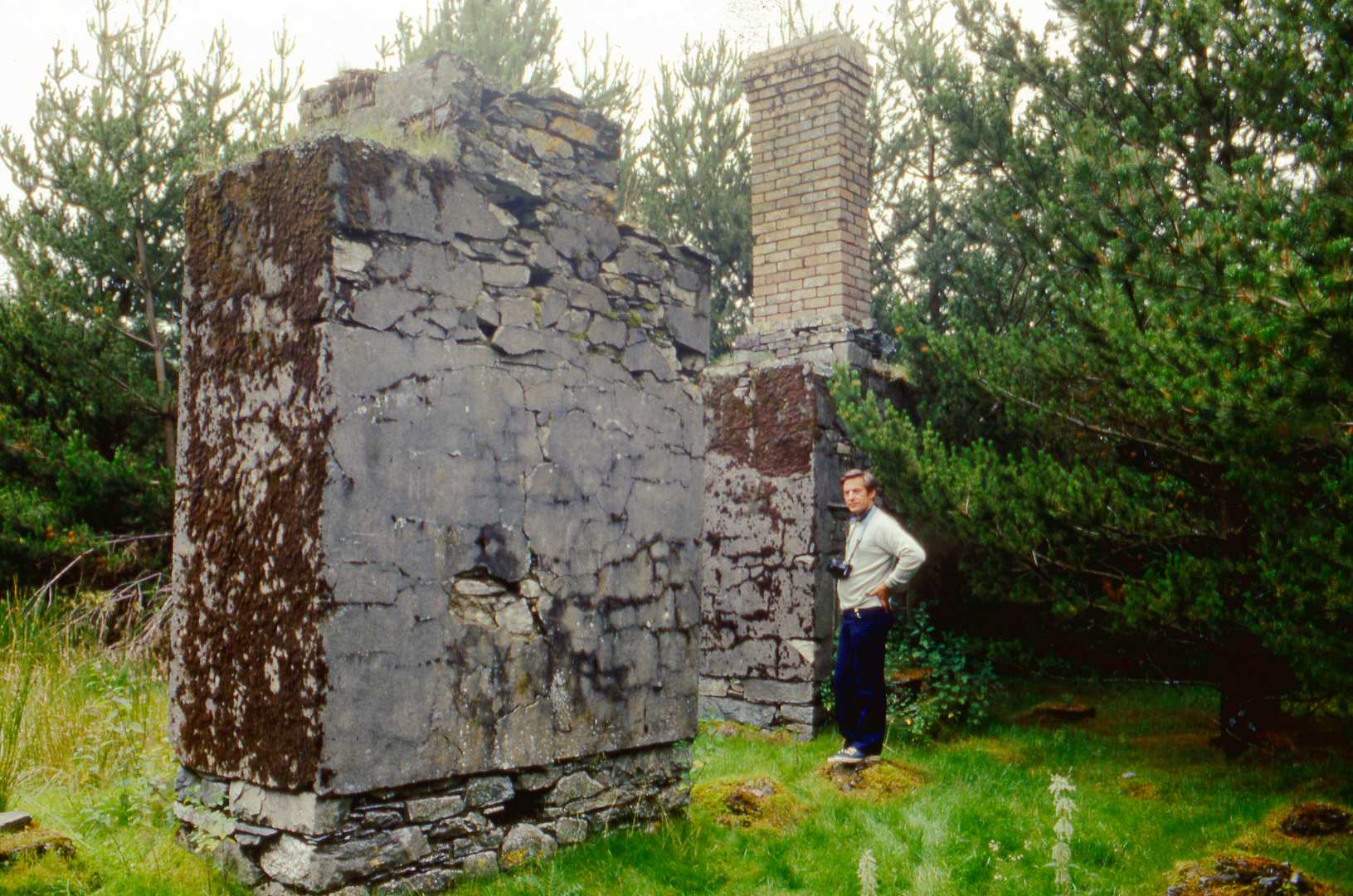
Approaching the mine from the road, one climbs spoil heaps into an area of building foundations with remaining chimney walls, the main adit is at the rear.
Roy Fellows, who has a great deal of involvement here, writes from that perspective in 2026:
When first visited in 1988 I discovered a long drive to a total collapse. Just before the end was a short passage on the left taking water. There was an obvious rudimentary belay, and I discovered that the winze had been descended by the now late Damien McCurdy and friends who had reached “a window into an enormous stope, but we were out of kit” This prompted me to rig the pitch for SRT and descend in a full wet suit. I reached the “window” and swung into a stope as described at the base of a huge rubble slope that had emanated from the infilling of what I now know as “Strides Shaft”. (Referred to in OT Jones as “Hafan Shaft”) I noted a bank of deads on my right but was unable to swing onto it. Shivering with cold from water running down into my wetsuit I decided to get back up. So far up there is a level to a forehead, and further up an alcove with partially fallen deadwork, I consider this as something of a hazard. The winze is about 50 -60 feet.
Some years later, poking about near the fall, I discovered a draughting hole in the floor. This was enlarged and enabled me to drop and electron and squeeze through. I found myself in stope workings and a short climb up took be to a point exactly behind the collapse. Here I found a small wheelbarrow, intact but partially in the fall. This was carefully removed to its present position.
Deeper in is another winze. This was descended to a blind floor at about 48 feet. I can find no trace of the (BGS) stated connection with Bog Shaft, a hardened mud inflow at one point may be it.
That was the state of things up to late 2018 when I decided to dig through into the big stope from above. I managed this nicely in time for the NAMHO 2019 event hosted by Cambrian Mines Trust. I roped the descending rubble slope previously described and found to my delight on a rock “RF 94”. I also managed to gain the top ogf the bank of deads which I now know to be the 5 fthm level and discovered a small iron kibble.
Back outside and higher up the wooded hillside is the site of shallow adit, now just a section of bogy ground. Slightly higher is Strides Shaft, fenced and gradually subsiding after being infilled some years ago. Further over is a pool in a bogy area which is a likely location for Bog Shaft.
Originally there was quite a few buildings and a headframe in this area, all gone bar some footings.
| Year | Activity |
|---|---|
| c1800 | Job Sheldon & Co reputadly made very good profit working Hafan. At the east part of the sett, they also worked the same lode as Henfwlch. |
| 1850 | Mining Company of Wales start deep adit driven under, and well beyond Hafan and under Henfwlch. |
| 1853 | Adit continued by Hafan and Henfwlch Co with Chairman James Stride, and MIchael Barbery managing operations. Stride’s Shaft hit very hard rock, with only 2ft sinking a week being achieved. |
| 1854 | With no improvement in Hafan or Henfwlch, company folds. |
| 1856 | Both mines working under a Captain Hughes. Down to 30fm below adit at Carriston’s Shaft |
| 1864 | Another company takes possession. Good ore found, |
| 1867 | By 1867 600 tons of lead ore sold - mainly from Henfwlch. |
| 1889/90 | Mines opened sporadically over previous years, 17 tons sold 89/90 |
Access Agreement between CAL and NRW/WG was terminated in 2022. Documentation for this lapsed agreement available here
https://buddlepit.co.uk/mine-explorer/Library/Library.html?doc=20963
External Links
Publications (22)
- (1848); BGS - Memoirs Vol II, Part II; 425 pages
- (1997); WMS Newsletter Issue 36 Jun; 8 pages
- (2001); WMS Newsletter Issue 45 Dec; 14 pages
- (2002); WMS Newsletter Issue 47 Oct; 28 pages
- A metal mines strategy for Wales; 139 pages
- Anon; Hafan-Henfwlch; 1 pages
- Anon; Henfwlch Waterfall Stope Sketch; 1 pages
- Bevins, R. E., (1994). National Museum of Wales Geological Series No.16 - A Mineralogy of Wales; ISBN: 0720004039; pp. 38,40,54,79,90,102,120,124.
- Bick, D.E. (1991); Old Metal Mines of Mid-Wales, The; North of Goginan - Part 3; pp. 46,48.
- Fellows, Roy (1997); Henfwlch mine explored
- Fellows, Roy; Henfwlch Mine Explored; 2 pages
- Foster-Smith, J.R.; NMRS (1979); British Mining 12 - Mines of Cardiganshire, The; ISBN 0 901450 14 6; p.33.
- Hall, G.W. (2014); Welsh Mines & Mining - Metal Mining in Mid Wales 1822-1921; 131 pages
- Hughes, S.J.S.; NMRS (1990); British Mining 40 - Darren Mines, The; ISBN 0901450 36 7; p.7.
- Hughes, Simon J.S. (1976); Cardiganshire - Its Mines and Miners; 52 pages
- Jones O.T. (1922); BGS - Mineral Resources of GB (c1920s) Vol XX - Lead and Zinc: Cardiganshire & West Montogmeryshire; 242 pages
- Liscombe & Co (1880); Mines of Cardiganshire, Montgomereyshire & Shropshire; 52 pages
- NMRS; British Mining 100 - Memoirs 2015; pp.61,63.
- NMRS; British Mining 80 - Memoirs 2006; pp.67-68.
- NMRS; Newsletter Aug/1979; p.2.
- NMRS; Newsletter Sep/1977; p.6.
- Shaw, R.P. (1982); PDMHS (Peak District Mines Historical Society) 08-3 Sum - Bwlch Glas Lead Mine, Cardiganshire; 6 pages (187-192)