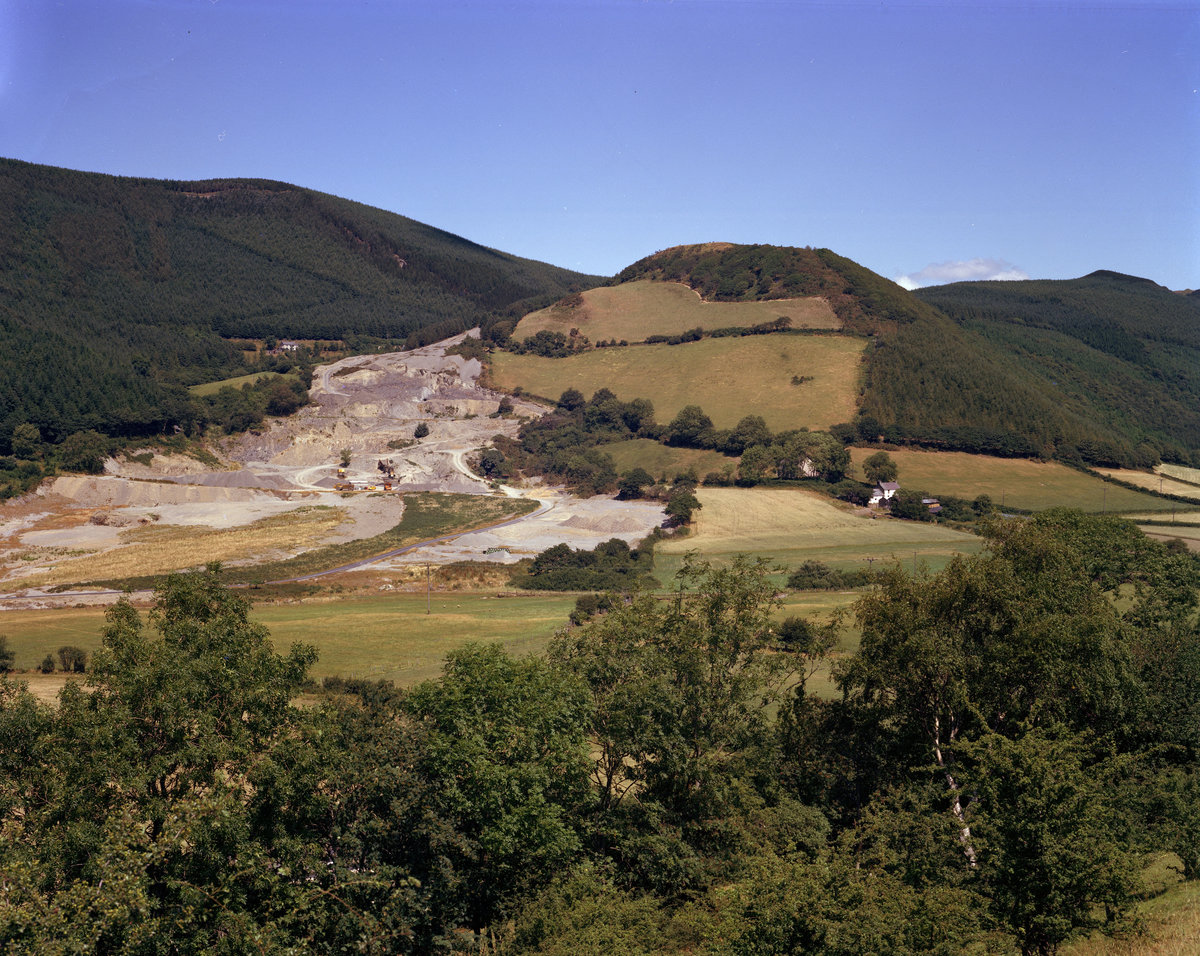



Circumstances suggest a likelihood of mining in the area since the Roman occupation, such as the discovery of Roman coins, however recorded history indicates an initial working by the Society of Mines Royal in 1583. This mine together with the neighbouring mines of Darren and Cwmsymlog were major silver producers and made fortunes for their owners. The mine later passed through the hands of the Mine Adventurers and into the 19th Century through a succession of owners including the ubiquitous John Taylor. The mine finally closed in 1886, however there were attempts to reopen by some small 20th Century concerns, the mine finally becoming totally abandoned in 1923. Little remains today of the original site which had about 12 waterwheels as well as dressing floors and other equipment, it covered a large area.
The site is described working upwards. The lowest remains are the cut and cover deep adit which emerges from the bank of the Avon Melindwr adjacent to the road bridge. This has been explored past a telegraph pole which penetrates it to a rising floor silt blockage. Nothing else remains below the minor road, it all being levelled and made into agricultural land.
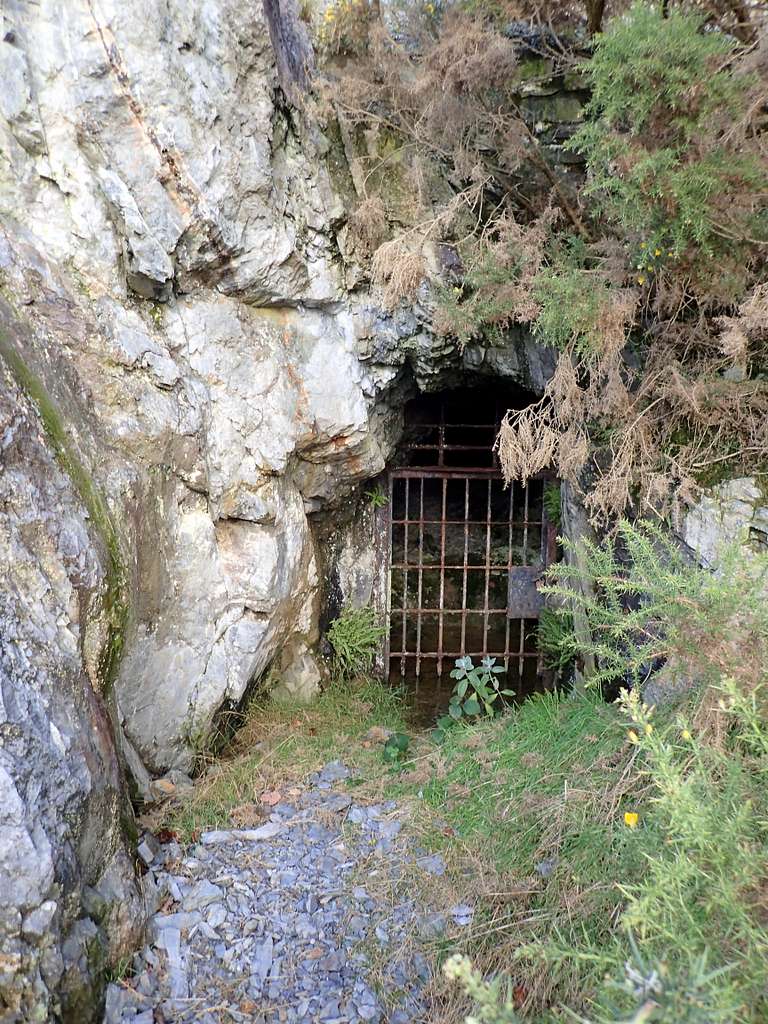
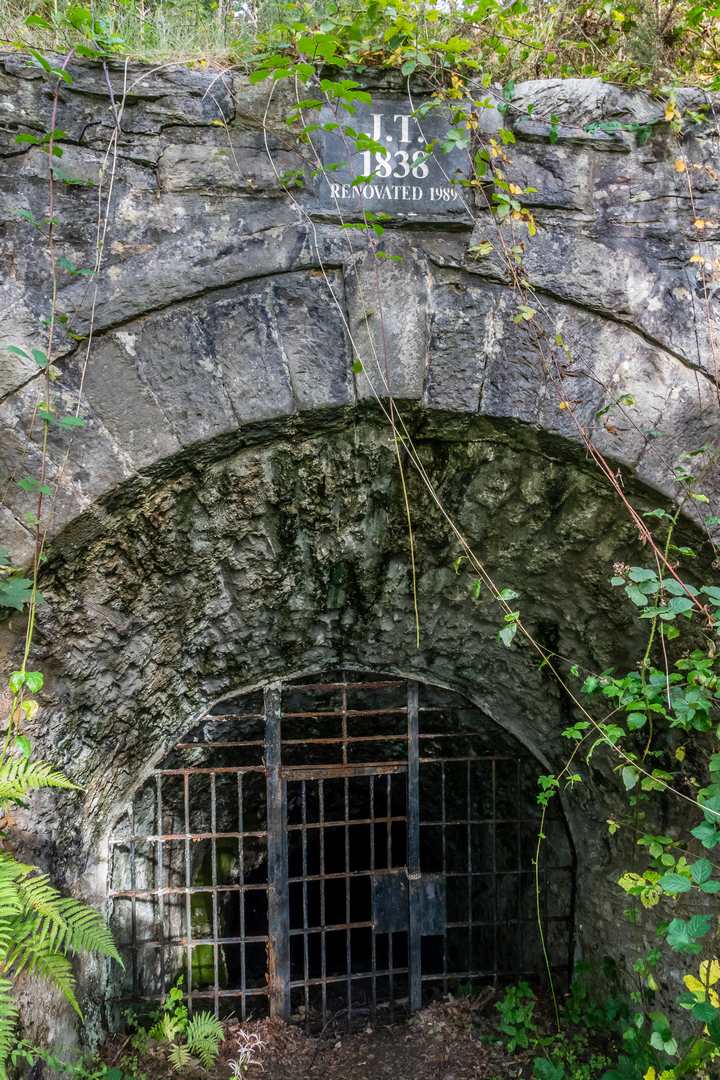
Above the road is private land in almost continuous usage, so permission should be sought before a planned visit. To the left of the entrance was Western Shaft and Tank’s Winze of which nothing remains and is probably the source of the deep adit blockage. However water does find its way out. Taylor’s Incline shaft, the portal of which was restored in 1989, is at SN690817. This leads down to the flooded 60 fathom level in which water is backed up making further progress normally impossible. It has twice been dived but without much success. In the drought of 2018 a 60 fthm south east exploratory level was discovered, photographed and surveyed. The 60 fthm drift onwards was not assessable, however It was possible to take a photo at this time using a dive camera, the workings inbye are in a state of collapse. See report.
The incline itself was originally water powered and shows sign of a twin track haulage system. Higher up the site, the 26 fathom level is open. This soon cuts an underground quarry which was used as a source of material for the mine buildings. It continues as a passage to the run in lower section of Francis’s Shaft. A dig was started by Welsh Mines Society in 2004 and although continued on and off for about 15 years was unsuccessful in reaching any explorable workings. The project was terminated as being beyond any reasonable chance of success, plus safety issues.
From the section its apparent that the inner workings are one massive stope extending all the way down to the deep adit, which is now collapsed, with working below being flooded.
There is a 50 fthm level now lost somewhere between the incline and the 26, probably buried under spoil from later workings. This was reported as being 3 feet high by 18 inches across.
At the top of the site is the open Francis’s Shaft which is open for about 70 feet but no workings off. Further over is Taylors Shaft, blocked a short distance down.
There are further workings, shaft remains etc extending over to Brynpica. There is an adit here at SN 693 820 virtually in the bed of the stream, of which there is now no trace. Years ago it was partially open and seen to be stone arched. It had been explored by the late Simon Hughes who reported that it was completely blocked after a short distance.
| Year | Activity |
|---|---|
| c1620 | Sir Hugh Middleton worked the mine for silver. |
| 1640s | Worked by Thomas Bushell who made a great fortune. |
| 1700 | Mackworth and William Waller, under the auspices of the Mine Adventurers made Goginan an early objective. Waller started by driving a level under the old stopes, commenting in 1706 to Mackworth ‘It proves a glorious work.. I doubt not but it will shortly be as wide as the Old Man had it, which was six or seven foot’. A few months later, he reported ‘the up forehead in Goginan the last Thursday was a yard wide full of small sparks of ore’. |
| 1710 | Mine Adventurers had only raised 20 tons of ore by this date. |
| 1744 | Mine still held by the Mine Adventurers. |
| 1834 | Arrival of John Taylor & Sons to Cardiganshire. At this date mine was owned by Samuel Hughes, an Aberystwyth solicitor who had not done much with it. |
| 1836 | The Taylors take a 21 year lease under manager Captain James Davey, who started clearing the 17C deep adit. |
| 1847 | Matthew Francis in charge. |
| 1840 | Machinery installed to support production of 100 tons or ore a month. Rather than a shaft, an incline was provided as a manway and also for drawing ore, this eventually powered by 36 foot waterwheel. |
| 1846 | BGS note 12 waterwheels at work, Taylor’s Shaft down to 110 m level with 400 men at work. 11,246 tons of ore raised in past 10 years. |
| c1850 | £5 shares changing hands for £250. |
| 1852 | Taylor’s Shaft reaches final depth of 142 fm, but production had dropped with only 50 men working. |
| c1880 | Closed. |
Private land in continuous use. PM Roy Fellows for landowner contact details.
External Links
Publications (55)
- (1848); BGS - Memoirs Vol II, Part II; 425 pages
- (1850); Cardiganshire - MJ Articles; 2 pages
- (1987); WMS Newsletter Issue 17 Dec; 5 pages
- (1988); WMS Newsletter Issue 18 May; 12 pages
- (1988); WMS Newsletter Issue 19 Dec; 6 pages
- (2000); WMS Newsletter Issue 43 Oct; 16 pages
- (2001); WMS Newsletter Issue 44 Apr; 10 pages
- (2001); WMS Newsletter Issue 45 Dec; 14 pages
- (2002); WMS Newsletter Issue 46 Apr; 23 pages
- (2003); WMS Newsletter Issue 49 Winter; 32 pages
- (2004); WMS Newsletter Issue 50 Spring; 40 pages
- (2004); WMS Newsletter Issue 51 Winter; 32 pages
- (2007); WMS Newsletter Issue 57 Autumn; 40 pages
- (2011); WMS Newsletter Issue 64 Spring; 44 pages
- (2011); WMS Newsletter Issue 65 Autumn; 48 pages
- (2018); WMS Newsletter Issue 79 Autumn; 40 pages
- A metal mines strategy for Wales; 139 pages
- Bevins, R. E., (1994). National Museum of Wales Geological Series No.16 - A Mineralogy of Wales; ISBN: 0720004039; pp. 45,117,120.
- Bick, D.E. (1991); Old Metal Mines of Mid-Wales, The; South of Goginan - Part 2; pp. 35-38.
- Bick, David; NMRS (1986); British Mining 30 - Frongoch Lead & Zinc Mine; ISBN 0901450 47 2; p.7.
- Bird, R.H., (1977); Yesterday's Golcondas: notable British metal mines; pp.43, 45; Moorland Publishing; 0903485370
- Fellows, Roy (2018); Goginan - Notes on Taylor's Incline; 2 pages
- Foster-Smith, J.R.; NMRS (1979); British Mining 12 - Mines of Cardiganshire, The; ISBN 0 901450 14 6; pp.10,43-44,52,73.
- Hall, G.W. (2014); Welsh Mines & Mining - Metal Mining in Mid Wales 1822-1921; 131 pages
- Hall, G.W. (2014); Welsh Mines & Mining - Metal Mining in Mid Wales 1822-1921; 131 pages
- Highes, Simon J.S.; NMRS (1988); British Mining 35; Goginan Mines, The
- Hughes, S.J.S.; NMRS (1981); British Mining 17 - Cwmystwyth Mines, The; ISBN 0 901450 20 0; pp.14,29,41.
- Hughes, S.J.S.; NMRS (1990); British Mining 40 - Darren Mines, The; ISBN 0901450 36 7; pp.10,18,20,22,27,37,50,60,69,82,86,112-113,136.
- Hughes, Simon J.S. (1988); UK Journal of Mines & Minerals No 5 - Decline of Mining in Mid Wales and Prospects of Revival, The; 10 pages
- Hughes, Simon J.S. (2005); Relics of German migration into Cardiganshire.; 11 pages
- James, D.M.D., (2025); Lode Geometry in the Central Wales Orefield, geological data from adit surveys and the archival record; pp,172; Self published by the author; 9781399975407
- Jarratt, Tony (1974); Logbook 1; 105 pages
- Jarratt, Tony (1981); Logbook 2; 121 pages
- Jarret, Tony; Goginan; 1 pages
- Jones O.T. (1922); BGS - Mineral Resources of GB (c1920s) Vol XX - Lead and Zinc: Cardiganshire & West Montogmeryshire; 242 pages
- Jones, Nigel and Walters, Mark and Frost, Pat (2004); Mountains and Orefields; 208 pages
- Joseph Yelloly Watson (1843); Compendium of British Mining, with Statistical Notices… & Glossary; 97 pages
- Liscombe & Co (1880); Mines of Cardiganshire, Montgomereyshire & Shropshire; 52 pages
- Misc; Goginan Various Plans; 1 pages
- Murchison, J.H. (1869); Lead Mines as an Investment; 34 pages
- Nancarrow (1919); Nancarrow Cardiganshire Report; 21 pages
- Naylor, Peter (1981); PDMHS (Peak District Mines Historical Society) 08-1 Jun - Sir Hugh Myddelton The First Mines Adventurer; 6 pages (54-59)
- NMRS; British Mining 37 - Memoirs 1988; pp.41-42,45.
- NMRS; British Mining 45 - Memoirs 1992; p.41.
- NMRS; British Mining 5 - Memoirs 1977; p.15.
- NMRS; British Mining 71 - Memoirs 2002; pp.9,11,18.
- NMRS; British Mining 80 - Memoirs 2006; p.81.
- NMRS; Newsletter May/1993; p.9.
- Palmer, M.; NMRS (1983); British Mining 22 - Welsh Potosi- "The Richest in all Wales"; ISBN 0 901450 24 3; pp.8,42.
- Palmer, Marilyn and Neaverson, Peter (1989); PDMHS (Peak District Mines Historical Society) 10-6 Win - Comparative Archaeology of Tin and Lead Dressing in Britain during the Nineteenth Century, The; 32 pages (316-347)
- Pritchard, R.J.; NMRS (1985); British Mining 27 - Rheidiol Mines, The; ISBN 0901450 21 9; pp.6,13.
- Timberlake, Simon (1994); PDMHS (Peak District Mines Historical Society) 12-3 Sum - Archaeological and Circumstantial Evidence for early Mining in Wales; 11 pages (133-143)
- Tucker, D.G. (1977); Sacking of the Francises by John Taylor 1841-2, The; 5 pages (14-18)
- Welsh Mines Society (Aut 2011); Newsletter 65
- Williams, R.A.; NMRS (1985); British Mining 26 - Old Mines of the Llangynog District, The; ISBN 0901450 27 8; p.48.