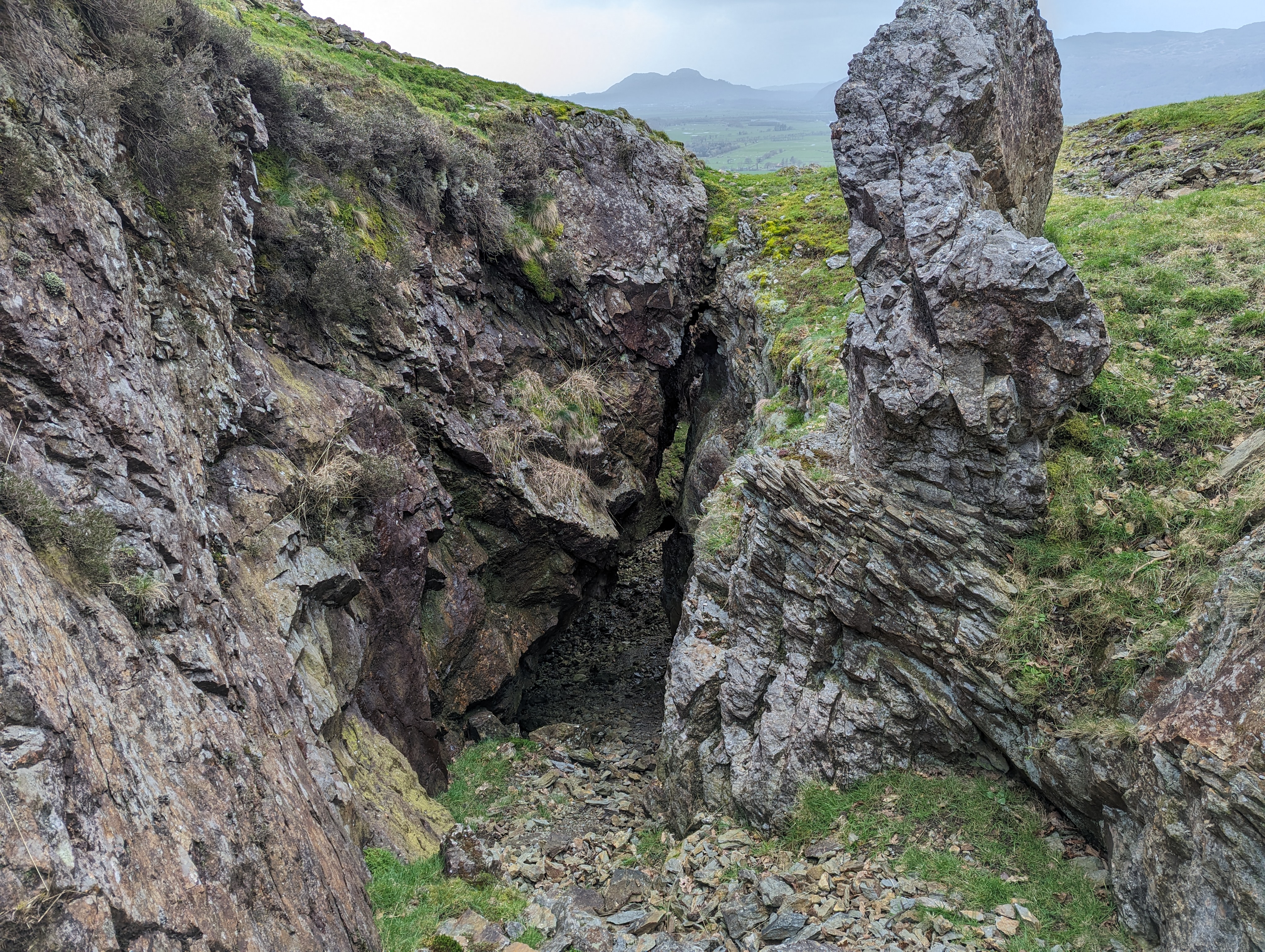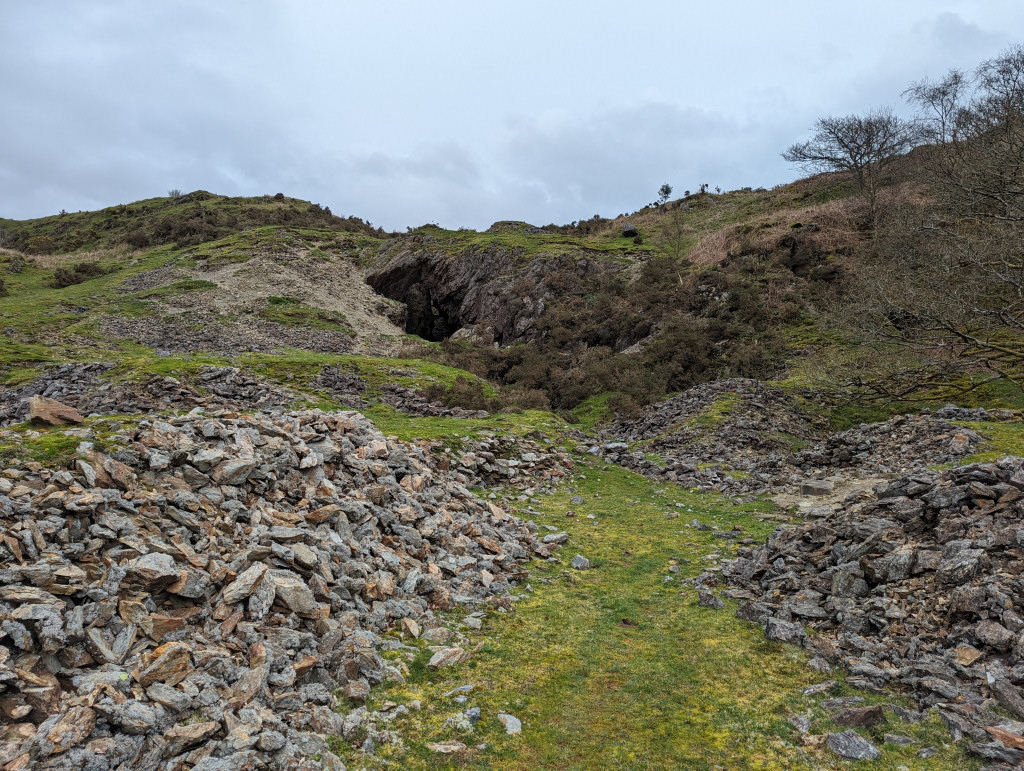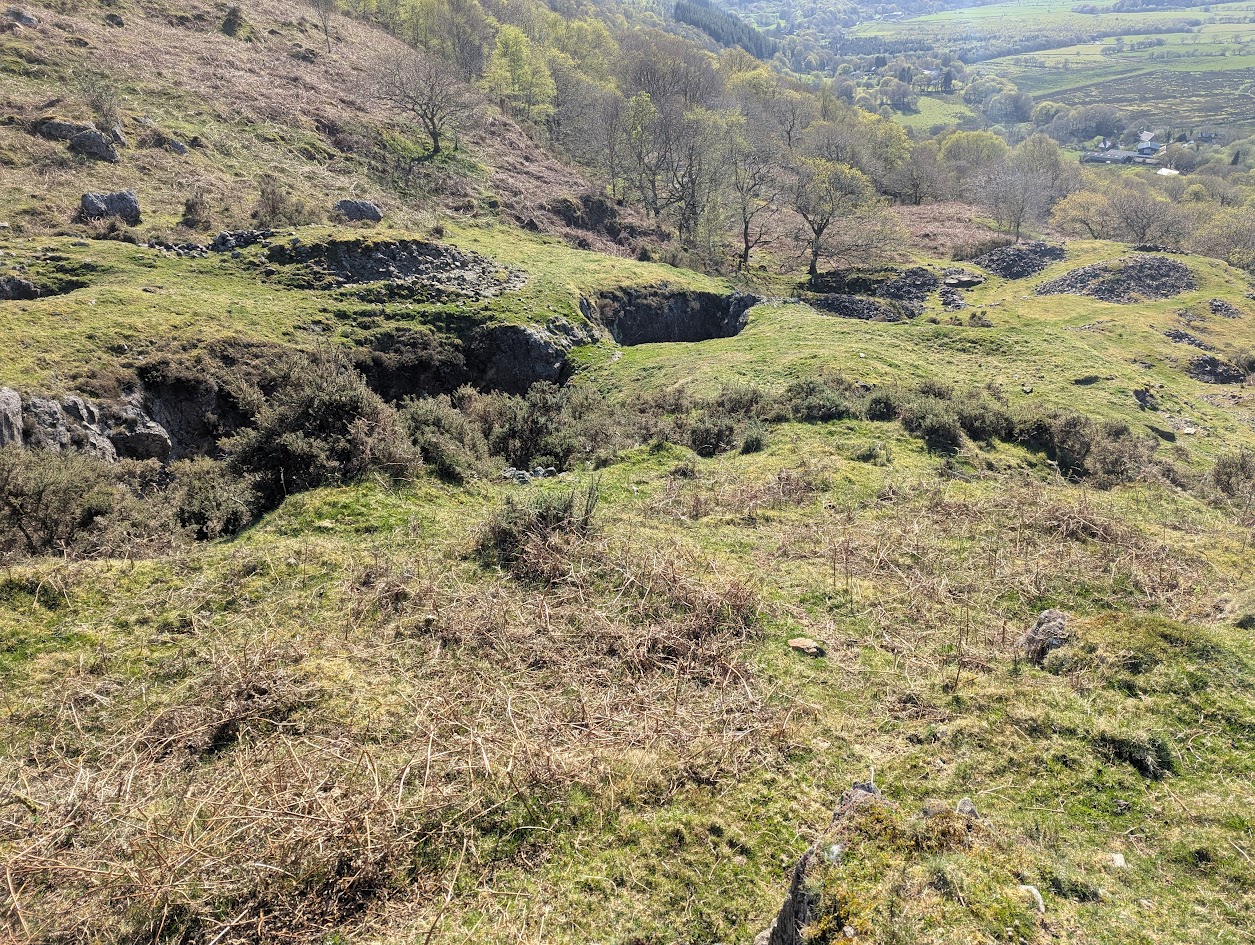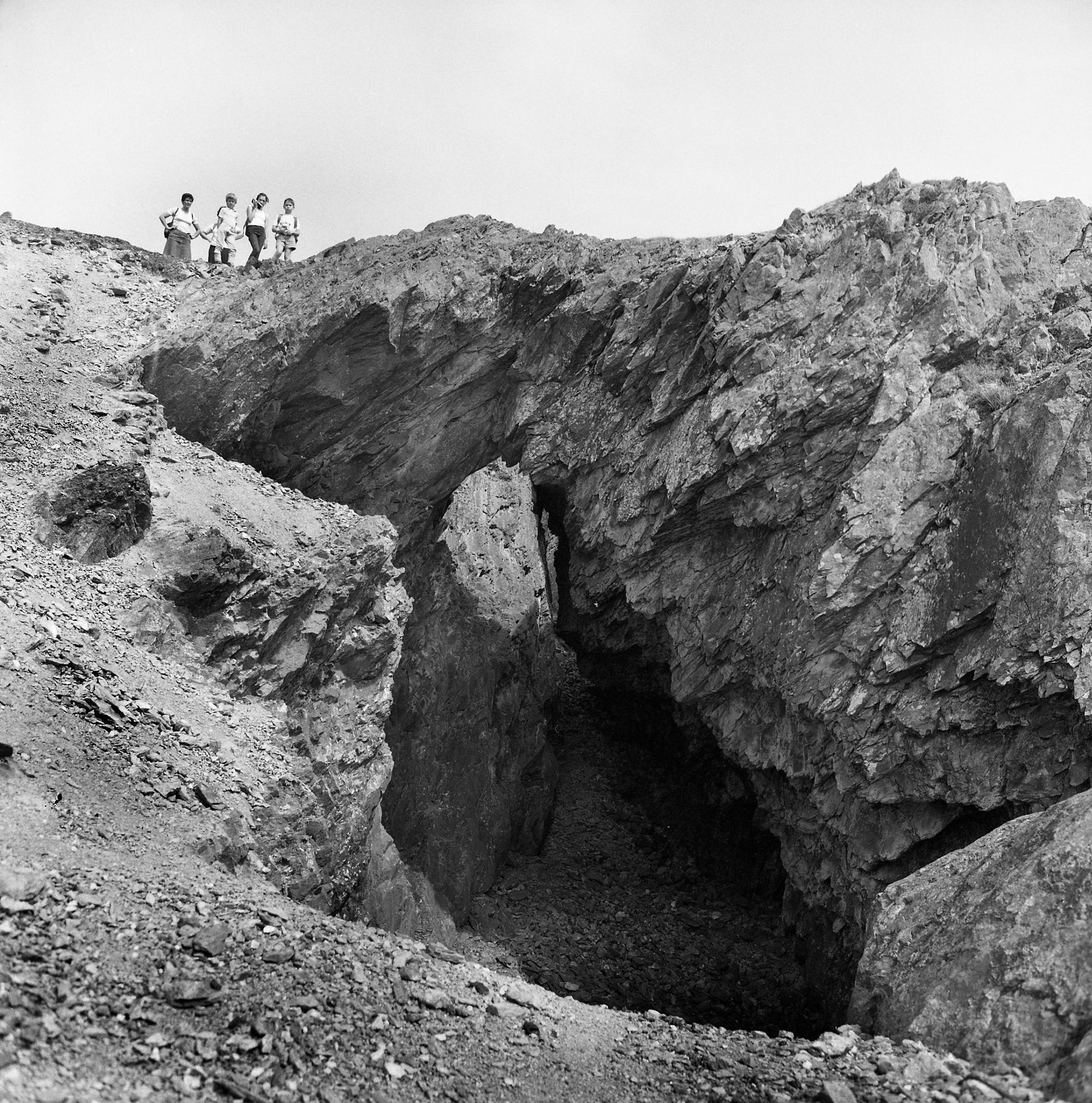



A separate set of workings from those traditionally accessed via the ‘deep adit’ and associated shafts. Situated on the hillside behind the farm, the route passes a blocked adit that feeds a large pond. At the top of the hill is a large gash—an open stope with a rock bridge that can be seen from Llanfrothen.
On the track leading from the road towards the farm, on the left is what appears to be a large, square-profiled flooded shaft.
Mining at Bwlch y Plwm likely began many centuries ago and is traditionally linked with Roman activity, with one vein later known as the Roman Lode. This vein was relatively unproductive and difficult to detect at the surface. Early working probably focused instead on the Main Lode, traced up the hillside to a large open cut near the ridge crest where rock lay close to the surface.
The earliest documentary reference comes from Edward Llwyd’s Parochialia of 1695, noting that lead had been dug near the church. A formal lease was granted in 1726 to Thomas Barker, though nothing is known of the results. Clearer evidence of organised mining survives from an account book dated 1795–1802, detailing wages, partnerships, tools, shareholder funding, and even beer supplied on ore-weighing days, illustrating the operation of a small lead mine.
After a long lull, renewed interest followed the Dolgellau gold rush. In 1854 the Mining Journal reported assay values suggesting gold, prompting new ventures. A company formed in 1863 attempted deeper working of the Main Vein using a waterwheel-powered pumping system. Although good ore was found, serious water problems and limited pumping power forced abandonment of this phase and a shift to driving a deep adit.
Financial disputes led to liquidation in 1868, though trustees continued limited work until a new company took over in 1875. Persistent efforts to cut the Main Lode from the deep adit proved inconclusive; while several veins were intersected—most notably the productive Lower Vein—the Main Lode itself may have pinched out at depth. The company was wound up in 1882.
Later activity was sporadic, with minor prospecting and limited work in the early 1920s by the Union Zinc Mining Co Ltd. Little evidence suggests significant production after this point, and the mine ultimately fell dormant.
Note: Despite not being any warning or fences in place - this is not a walk in mine, you need mine explorers skills, awarness and technical equipment.
The farm iself appears to be a holiday let these days, and there is a public footpath from the road up to the workings.
External Links
Publications (2)
- (1997); Ogofa GCPC Journal No 5, Spring; 53 pages
- Smith B., Dewey H. (1922); BGS - Mineral Resources of GB (c1920s) Vol XXIII - Lead & Zinc: Pre-Carboniferous Shropshire & North Wales; 111 pages