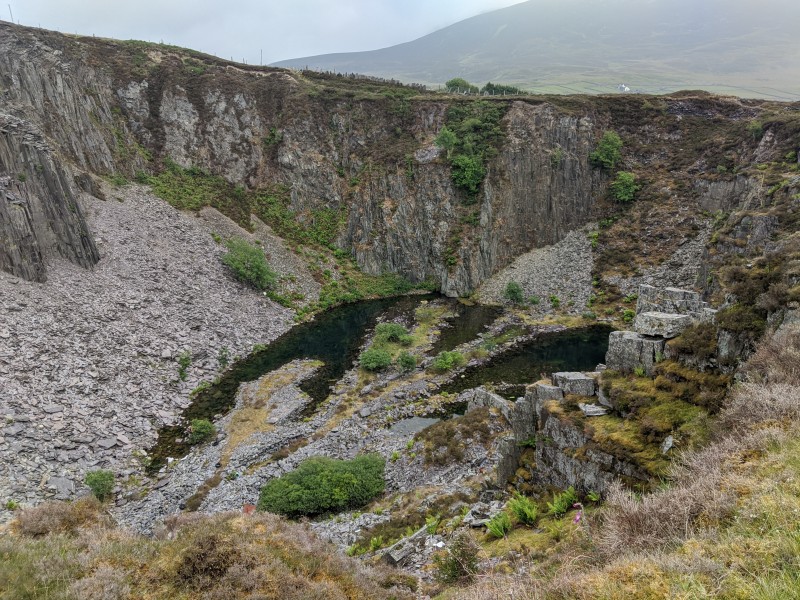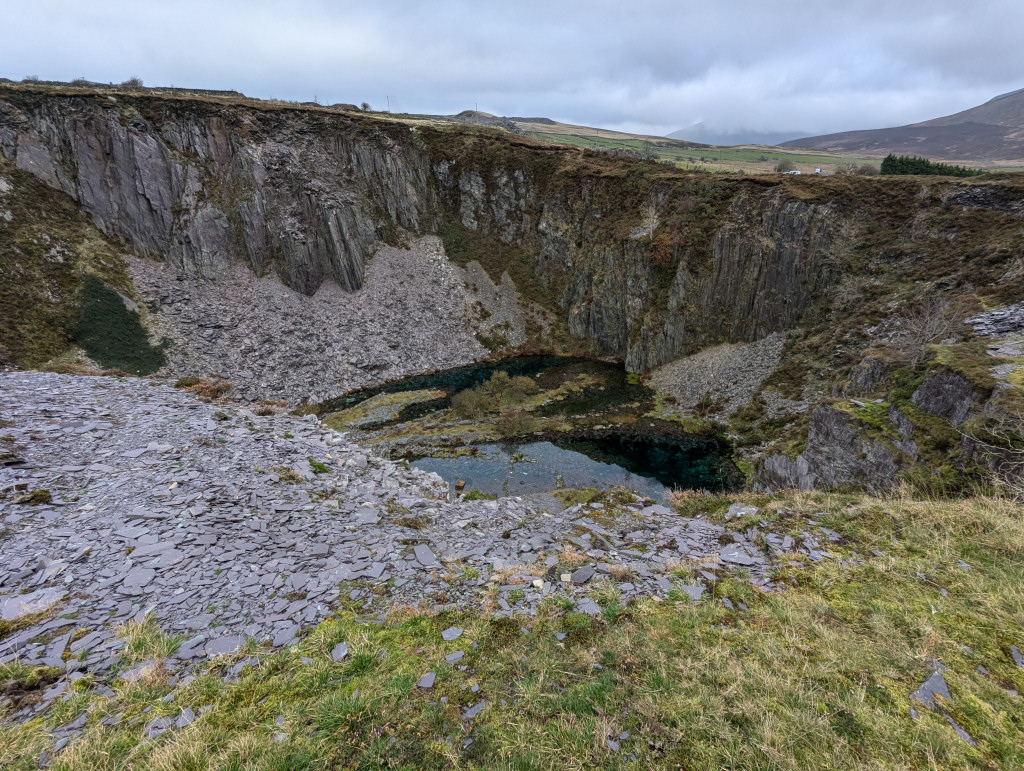



Two pits joined by short tunnel.
The site centres on a large main pit surrounded by extensive waste tips, with the upper banks merging seamlessly into the Old Braich tip complex. These elevated areas are now largely featureless, having been subjected to tip reworking and modern landscaping, though the exit tramway ramp remains identifiable. On the lower eastern tips, fragmentary remains of the old mill and the pump waterwheel pit can still be traced. Near the farm track, two crossed railway sleepers mark the position of a late-period cableway employed during the final reworking phase. Beyond the immediate quarry site, the former rail route to the Drumhead is still extant.
Fron Quarry developed around 1830 as two pits connected by a short tunnel. Early pumping arrangements probably relied on water power, but from the 1860s the quarry embraced steam technology, installing a steam-powered mill and a chain incline to replace the earlier water balance. Steam locomotives also came into use, with the fleet eventually growing to three engines. In 1886, the quarry absorbed the neighbouring Braich Rhyd working, swelling its workforce to around 100 men. Despite this expansion, annual output likely never exceeded 1,500 tons, and production fell sharply in the late 1870s—by 1883, only 728 tons were produced by 62 men. Transport arrangements evolved significantly over the decades: in 1868, the Fron tramway replaced the laborious use of carts, and from 1881 it connected directly with the NWNGR Bryngwyn inclines. A small amount of extraction continued sporadically into the 1930s.
Publications (6)
- Gwyn, David, (2015); Welsh Slate: archaeology and history of an industry; Royal Commission on the Ancient and Historical Monuments of Wales; 9781871184518
- Jones, Gwynfor P., Richards, Alun J. (2004); Cwm Gwyrfai; pp.239-272; Gwasg Carreg Gwalch ISBN 0-86381-897-8
- Lindsay, Jean (1974); History of the North Wales Slate Industry; David & Charles; pp.319; ISBN 0-71536-264-X
- Richards, Alun J. (2013); Slate Quarrying in Wales; Gwasg Carreg Gwalch; ISBN 1-84527-026-6
- Richards, Alun John (1991); Gazeteer of the Welsh Slate Industry, A; Gwasg Carreg Gwalch 978-0863811968
- Richards, Alun John, (1999); The Slate Regions of North and Mid Wales and their Railways; Gwasg Carreg Gwalch; 0863815785