



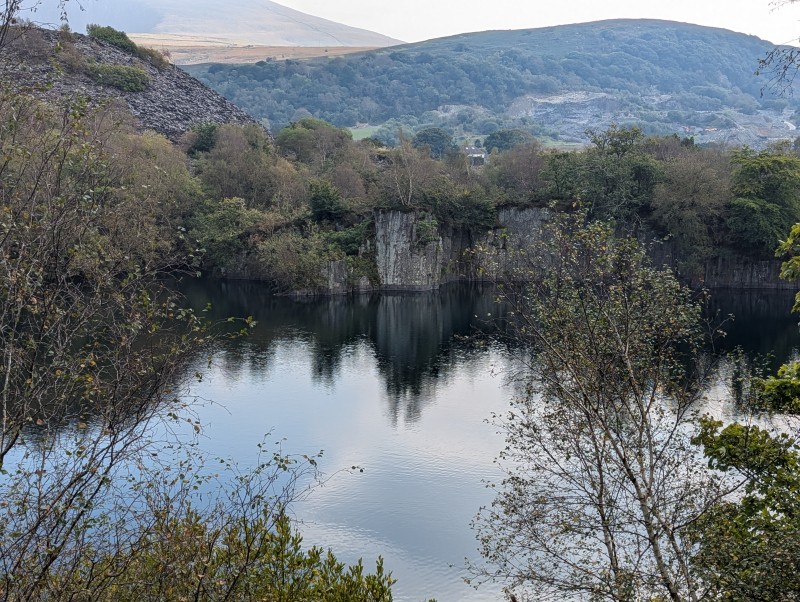
The pit now lies submerged beneath water. Several structures remain standing, though all are in a ruinous state.
Quarrying began here in 1867 on a site with earlier workings dating back to around 1760, traditionally attributed to Cornish copper miners from Drws y Coed. The processing mill was built on a waste bank and served by a Blondin aerial ropeway. In 1882, seventy men worked at the quarry, producing 1,040 tons, with output increasing further as the nineteenth century drew to a close. The operation benefited from a connection to the Nantlle Railway. From 1899 onwards, waste material was transported across the River Llyfni to the south using a timber bridge, which gave way in 1927. The quarry later merged with Tal y Sarn before being absorbed into Dorothea in 1921.
Publications (12)
- (2000); WMS Newsletter Issue 43 Oct; 16 pages
- (2002); WMS Newsletter Issue 47 Oct; 28 pages
- (2003); WMS Newsletter Issue 48 Apr; 32 pages
- Gwyn, David, (2015); Welsh Slate: archaeology and history of an industry; Royal Commission on the Ancient and Historical Monuments of Wales; 9781871184518
- le Neve Foster, C. (1896); Mines & Quarries Report-North Wales; 57 pages
- Lindsay, Jean (1974); History of the North Wales Slate Industry; David & Charles; pp.331; ISBN 0-71536-264-X
- NMRS (1971); Memoirs Vol2, No.1; pp.19-20, pl.1.
- NMRS; Newsletter Dec/2001; p.9.
- NMRS; Newsletter Sep/1984; p.2.
- Richards, Alun J. (2013); Slate Quarrying in Wales; Gwasg Carreg Gwalch; ISBN 1-84527-026-6
- Richards, Alun John (1991); Gazeteer of the Welsh Slate Industry, A; Gwasg Carreg Gwalch 978-0863811968
- Richards, Alun John, (1999); The Slate Regions of North and Mid Wales and their Railways; Gwasg Carreg Gwalch; 0863815689

