


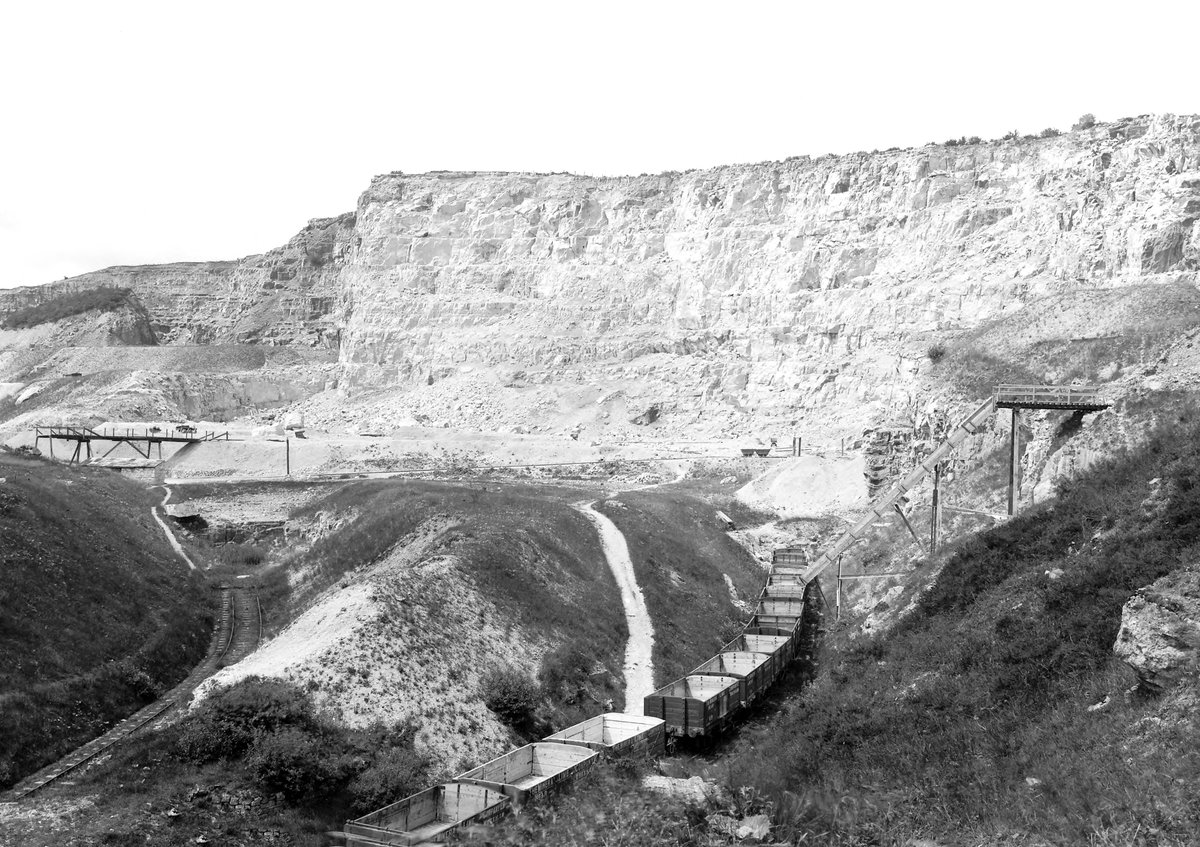
The Minera Limeworks site today is a blend of industrial heritage and natural conservation. Visitors can still see the surviving kilns, including the rare Hoffmann kiln, alongside the remains of quarrying infrastructure.
The former quarry is now managed as a wildlife reserve by the North Wales Wildlife Trust. Paths and restricted access points guide the public safely through the area, balancing heritage preservation with habitat protection.
The site also has geological and speleological significance: cave entrances such as Ogof Dydd Byraf and Ogof Llyn Du begin within the quarry, linking to underground river systems and coming close to major cave networks like Ogof Cefn-y-Gist and Ogof Llyn Parc.
Works closed in 1972, the quarry continued producing roadstone up to 1993.
Limeburning at Minera has been recorded as early as 1620, but large-scale industrial operations began with the founding of the Minera Lime Company in 1852. By 1859, the quarries in the Minera area were producing an estimated 300,000 tons of stone, with around 200,000 tons converted into lime.
The company became a limited concern in 1865, attracting major investment. With this funding, a Hoffmann kiln was built—originally designed for brickmaking but adapted for limeburning. This kiln still survives and is one of only three purpose-built limeburning Hoffmann kilns remaining in the UK, the others being at Langcliffe (Yorkshire) and Llanymynech Limeworks.
At its peak, the works featured extensive kilns, its own steam locomotive, and hundreds of wagons for coal and lime. The Minera Lime Co. even appeared in model form through Hornby Railways and Dapol. The limeworks eventually closed in 1972, and the railway branch serving the site was dismantled soon after.
Limestone quarrying for road building materials continued until 1993. Afterwards, the site was used for storage, though plans for redevelopment stalled. In 2004–05, a major cleanup flattened the quarry floor. Ownership later passed to Lafarge Aggregates, who secured the site but did not restart operations.
In 2005, the Minera Quarry Trust was formed to conserve the area for public benefit, working with the North Wales Wildlife Trust and supported by Wrexham County Borough Council. Tarmac, the previous owners, donated the land (for £1) along with £100,000 for safety works. On 2 June 2018, the site was officially opened by Mike Dilger as the 36th Wildlife Reserve in North Wales.


